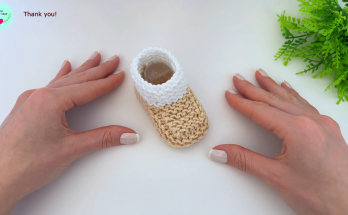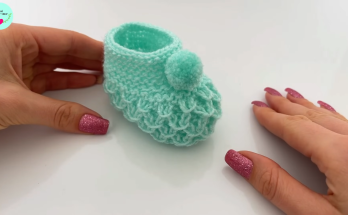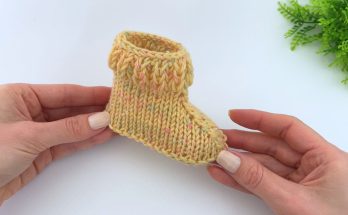

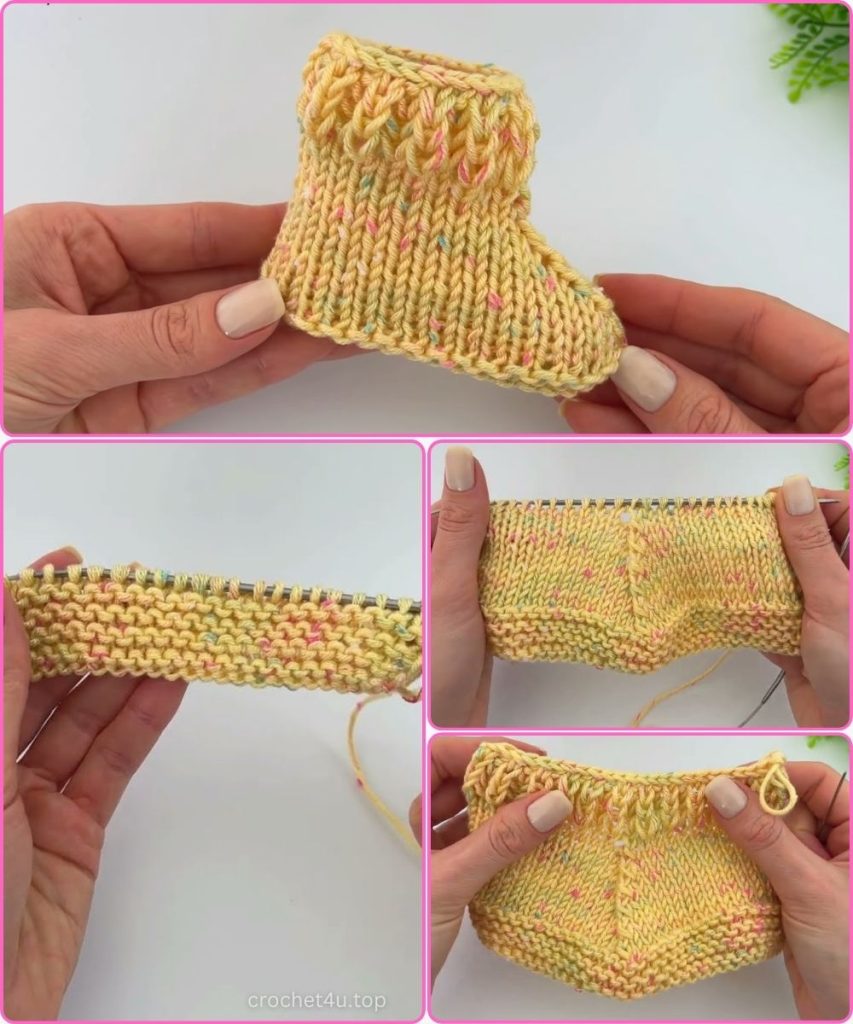
Welcome to a truly magical pattern! Inspired by a classic knit construction, this bootie is entirely worked flat and then meticulously seamed to create a beautiful, structured shoe with a clean sole and a textured cuff. The design uses simple single and double crochet techniques combined with strategic post stitches to mimic the rich, voluminous textures often found in knitwear.
This pattern is a fantastic introduction to shaped construction and will result in a sturdy, cozy, and elegant bootie for a special little one!
🧶 Materials & Tools
For the best texture and structure, a yarn with good stitch definition is recommended.
- Yarn: Approximately 70-80 grams of Light Worsted or DK Weight yarn (Category 3). A wool blend or acrylic with good bounce will enhance the ribbed cuff.
- Hook: 3.5 mm (US size E/4) or 4.0 mm (US size G/6) crochet hook. Use the size that gives you a tight, dense fabric.
- Notions:
- Tapestry needle (essential for seaming and weaving in ends).
- Scissors.
- Measuring tape.
- Stitch markers (to mark the center decrease stitches).
📏 Sizing & Gauge
This pattern is written for a standard newborn size, but its flexibility allows for easy modification.
Standard Size: Newborn (0-3 Months)
- Starting Chain: Chain 37. (This provides approximately 18-20 cm / 7-8 inches of circumference).
- Requirement: The initial chain count must be an odd number (35, 37, 39, etc.) for the centered toe decrease to work symmetrically.
- Finished Sole Length: Approximately 9.5 cm (3.75 inches).
Adjusting the Size
The length of the starting chain determines the circumference of the foot.
- Rule of Thumb: Measure the baby’s foot from heel to toe, then chain a length equal to double that measurement in circumference. Ensure the final count is odd.
- Body Height: Adjust the number of rows in Part 2 to change the depth of the toe shaping.
📘 Abbreviations & Special Stitches (US Terms)
We will use standard stitches and two crucial techniques to achieve the desired textures.
| Abbreviation | Stitch Name |
| ch | Chain |
| st(s) | Stitch(es) |
| sl st | Slip Stitch |
| sc | Single Crochet |
| hdc | Half Double Crochet |
| dc | Double Crochet |
| BLO | Back Loop Only |
| FPDC | Front Post Double Crochet |
| BPDC | Back Post Double Crochet |
| SC3tog | Single Crochet Three Together |
Special Technique 1: Garter Stitch Mimic (HDC in BLO)
Working the HDC stitch into the Back Loop Only (BLO) on every row creates prominent horizontal ridges on the Right Side (RS) that closely resemble the knitted garter stitch (“ponto tricô”). This texture is used for the initial cuff and toe shaping section.
Special Technique 2: Post Stitch Ribbing (FPDC/BPDC)
Using FPDC and BPDC creates a stretchy, deep ribbing that gives the upper cuff its volume, mimicking the knitted brioche or English rib (“barra inglesa”).
🧱 Part 1: The Cuff/Base Panel (Garter Mimic)
This section creates the foundation and the first part of the fold-over cuff, using the HDC in BLO technique.

Preparation: Chain 37.
Row 1 (Foundation):
- HDC in the 2nd ch from the hook and in every chain across.(36 HDC)
Row 2 (Garter Mimic):
- Ch 1 (does not count as a stitch). Turn your work.
- HDC in the BLO of the first stitch and in the BLO of every stitch across.(36 HDC)
Rows 3 – 8 (Cuff Repeat):
- Repeat Row 2 until the piece measures approximately 2.5 cm (1 inch) in height (about 7-8 rows).
🔽 Part 2: The Toe Shaping (Centered Decreases)
We now shape the body of the bootie by introducing decreases along the center of the row. This forms the tapered toe section.
Row 9 (First Decrease Row):
- Ch 1. Turn your work.
- HDC in the BLO of the next 17 stitches. (This sets the side panel).
- Decrease Section: Work HDCdec over the next 2 stitches (reducing 2 sts to 1).
- HDC in the BLO of the last 17 stitches.(35 HDC remaining)
Row 10 (Stabilizing Row – No Decrease):
- Ch 1. Turn your work.
- HDC in the BLO of every stitch across.(35 HDC)
Row 11 (Second Decrease Row):
- Ch 1. Turn your work.
- HDC in the BLO of the next 16 stitches.
- Decrease Section: Work HDCdec over the next 2 stitches.
- HDC in the BLO of the last 16 stitches.(33 HDC remaining)
Row 12 (Stabilizing Row – No Decrease):
- Ch 1. Turn. HDC in the BLO of every stitch across.(33 HDC)
Rows 13 – 18 (Continue Decreases):
- Continue alternating decrease rows and stabilizing rows until you have worked 6 decrease rows in total.
- The number of side stitches will decrease by one on each side in every decrease row.
- By the end of Row 18, you should have 27 HDC remaining, with 12 HDC on each side of the central HDC.
🌊 Part 3: The Voluminous Upper Cuff (Post Stitch Rib)
We now switch to a true ribbed texture to create a stretchy, foldable cuff.

Row 19 (Rib Setup):
- Ch 3 (counts as first DC). Turn your work.
- DC in the next st and in every st across.(27 DC)
Row 20 (Ribbing Row 1):
- Ch 3 (counts as first DC). Turn your work.
- Begin Ribbing: FPDC around the post of the next DC.
- BPDC around the post of the next DC.
- Repeat
FPDC around next DC, BPDC around next DCacross the row. - Finish with a DC in the top of the beginning Ch 3.(27 sts)
Row 21 (Ribbing Row 2):
- Ch 3 (counts as first DC). Turn your work.
- Work the post stitch as it presents: You should be working FPDC around the previous FPDC and BPDC around the previous BPDC.
- Repeat this 1×1 ribbing across the row.
- Finish with a DC in the top of the beginning Ch 3.(27 sts)
Rows 22 – 24 (Ribbing Repeat):
- Repeat Row 21 three more times, or until the ribbed section measures approximately 2 cm (0.8 inches) in height.
Final Finishing of Panel:
- Cut the yarn, leaving an extremely long tail (at least 60 cm / 24 inches) for seaming. Pull the tail through the last loop to fasten off.
✂️ Part 4: Assembly and Shaping
The final steps involve seaming the bootie to create its three-dimensional form.

1. Seam the Ankle/Cuff (Heel)
- Fold: Turn the entire piece to the Wrong Side (WS). Fold the piece in half lengthwise so the two short ends (Row 1 to the final row) align.
- Seam: Use the long tail and a tapestry needle to securely sew the short edges together. Start at the top of the cuff and sew down to the bottom edge (the foundation chain). This forms the back of the heel.
- Secure: Knot securely at the bottom edge.
2. Seam the Sole (Cinching and Closure)
- Sole Seam: Now, align the two long, raw edges (the starting chain and the last row edge) and sew them together. Use a strong whipstitch or mattress stitch. Sew about 4 cm (1.5 inches) from the heel seam toward the toe end.
- Cinch the Heel: Before continuing the main sole seam, go back to the heel corner and work a running stitch through the loops along the corner. Pull the thread firmly to cinch the heel corner into a rounded shape. Knot securely.
- Sole Seam Continuation: Continue the main sole seam toward the toe until you are about 2 cm (0.8 inches) from the end of the toe panel.
- Gather the Toe: Using a running stitch, pass the needle through the last few stitch loops along the entire remaining edge of the toe tip.
- Pull Tightly: Pull the thread firmly to cinch the entire toe tip closed, creating the pointed, shaped toe. Knot securely and weave the excess tail into the sole seam to hide it.
Video Tutorial:
💖 Final Touches & Variations
- Turn Right Side Out: Turn the bootie to the right side and gently shape the toe and heel.
- Cuff Fold: Fold the ribbed cuff (Part 3) outward and downward to create the cozy, voluminous collar.
- Embellishments (Optional):
- Pompom: Attach a small, handmade pompom (matching the yarn) to the top center of the toe.
- Tie: Thread a ribbon or crocheted chain through the lower edge of the cuff (Row 19) before folding, allowing you to tie a bow at the front.
Repeat all steps for the second bootie. Enjoy the warmth and beautiful construction of your finished Magical Flat-Panel Booties!