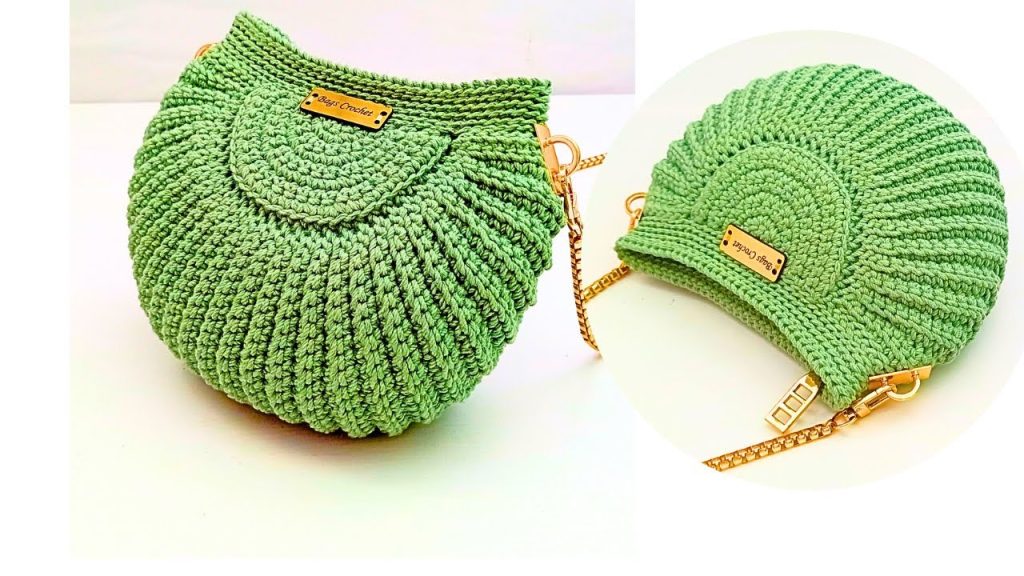
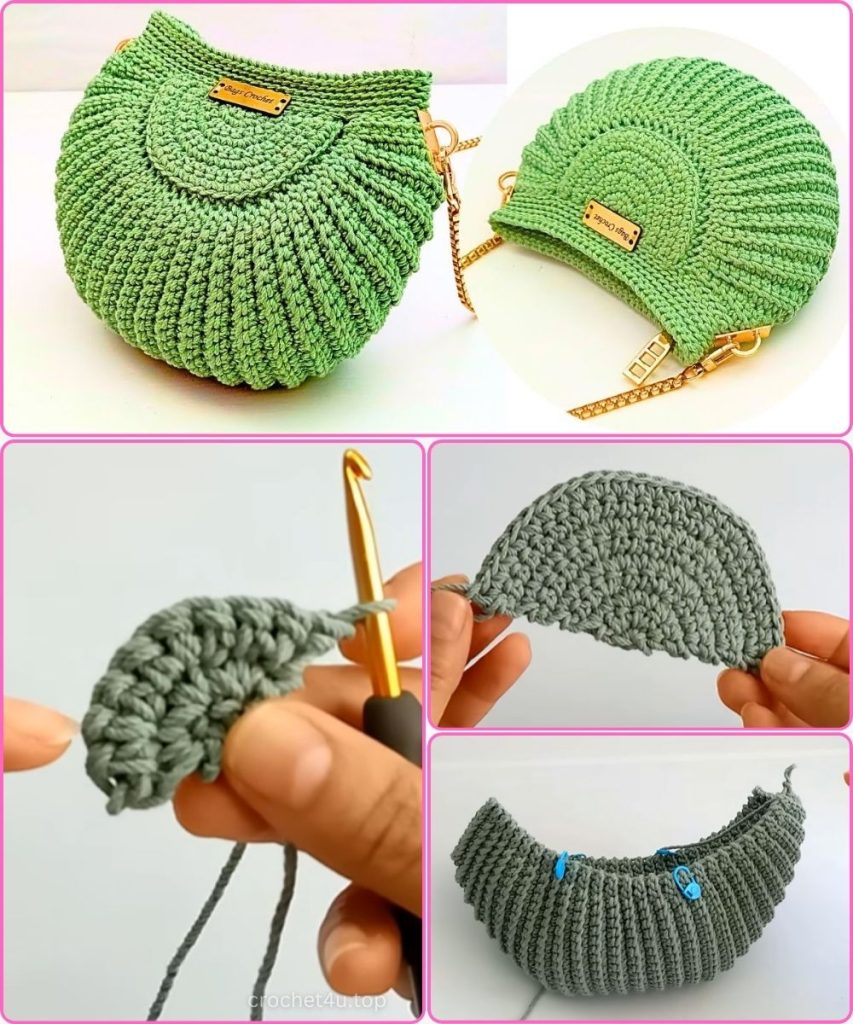
Welcome to today’s project! We are crafting a stunning, high-fashion petite bag that looks like it belongs in a boutique window. This “Shell-style” bag uses a clever geometric construction that is surprisingly simple for beginners. By combining two half-circles with a textured center gusset, we create a structured, sturdy accessory perfect for any occasion.
🧶 The Artisan’s Toolkit: Materials & Specifications
Before we pick up the hook, let’s talk about why these specific materials matter.
- The Yarn: 250g of Cotton Macramé Cord (2mm – 3mm thick). * Pro Tip: Cotton macramé is preferred over polyester because it provides a “matte” luxury finish and has zero “give,” ensuring your bag won’t sag when you put your phone and keys inside.
- The Hook: 4.0mm (G/6). We are looking for a tight, dense gauge. If you tend to crochet loosely, drop down to a 3.5mm.
- The Hardware: * Zipper: 20cm (approx. 8 inches). It should be slightly longer than the bag opening for easier installation.
- D-Rings: 2 small metal rings for the strap attachment.
- Strap: A metallic gold or silver chain to elevate the “boutique” look.
- Notions: 4 Stitch markers, tapestry needle (large eye), and a sharp pair of scissors.
📐 The Blueprint: Understanding the Geometry
The secret to this bag’s professional finish is the 2-to-1 Ratio.
- Our side panels (the half-circles) end with 27 stitches.
- The body gusset (the long strip) consists of 54 rows.
- This means when we join them, every one stitch on the circle will align perfectly with two row-ends on the gusset. This prevents the fabric from bunching or stretching.
🎨 Part 1: The Sculpted Side Panels (Make 2)
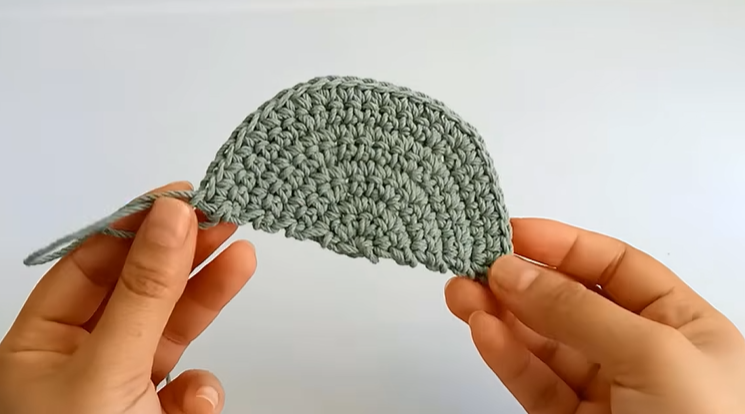
We are creating two flat half-circles. The goal here is a perfectly flat semi-circle with no curling at the edges.
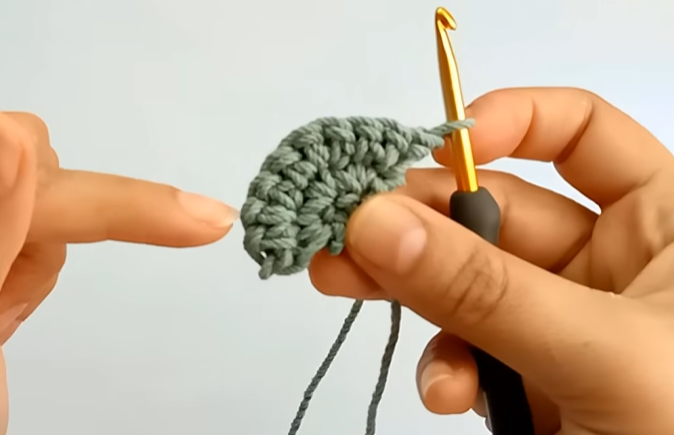
- Foundation: Create a Magic Ring.
- Row 1: Work 3 SC into the ring. Do not join in a circle. Pull the tail tight. Ch 1, turn.
- Row 2: Work 2 SC in each of the 3 stitches. (6 sts). Ch 1, turn.
- Row 3: [1 SC in the first st, 2 SC in the next st] — Repeat across. (9 sts). Ch 1, turn.
- Row 4: [1 SC in the next 2 sts, 2 SC in the next st] — Repeat across. (12 sts). Ch 1, turn.
- Row 5: [1 SC in the next 3 sts, 2 SC in the next st] — Repeat across. (15 sts). Ch 1, turn.
- Row 6: [1 SC in the next 4 sts, 2 SC in the next st] — Repeat across. (18 sts). Ch 1, turn.
- Row 7: [1 SC in the next 5 sts, 2 SC in the next st] — Repeat across. (21 sts). Ch 1, turn.
- Row 8: [1 SC in the next 6 sts, 2 SC in the next st] — Repeat across. (24 sts). Ch 1, turn.
- Row 9: [1 SC in the next 7 sts, 2 SC in the next st] — Repeat across. (27 sts).
Finishing: Fasten off for the first panel. For the second panel, keep the yarn attached to begin the assembly later.
🧱 Part 2: The Multi-Phase Body Gusset
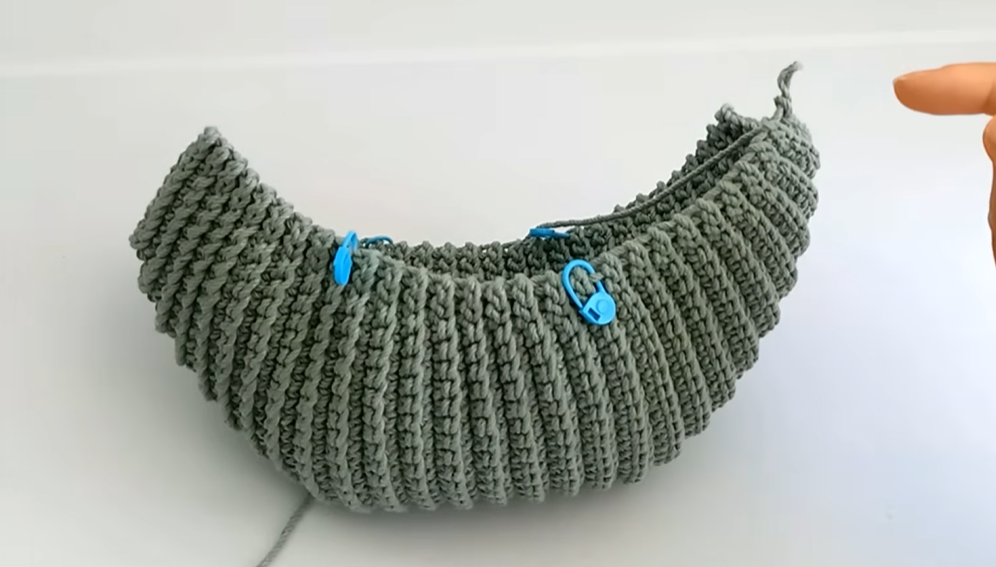
This long strip creates the “walls” and the bottom of the bag. We work in BLO (Back Loop Only) to create a ribbed texture that allows the gusset to bend smoothly around the curves of the circle.
Phase A: The Opening Expansion (Rows 1–18)
- Foundation: Chain 16.
- Row 1: Starting in the 2nd ch from hook, work 2 Sl St, 5 SC, 3 SC in the next st (this is your center peak), 5 SC, 2 Sl St. (17 sts). Ch 1, turn.
- Row 2 (Stable): Work 2 Sl St (BLO), 13 SC (BLO), 2 Sl St (BLO). (17 sts). Ch 1, turn.
- Row 3 (Increase): Work 2 Sl St, 6 SC, 3 SC in the center st, 6 SC, 2 Sl St. (19 sts).
- Repeat: Continue this alternating pattern (one Increase row, one Stable row) until you reach Row 18. At this point, your piece will have a slight chevron “V” shape.
Phase B: The Structural Base (Rows 19–37)
Now we need the bag to have a consistent width for the bottom.
- Work 19 rows of “Stable” stitches only.
- Each row: 2 Sl St at the start, SC in all middle stitches, 2 Sl St at the end (all BLO).
Phase C: The Closing Contraction (Rows 38–54)
To mirror Phase A, we now use “3-into-1” decreases.
- Decrease Row: Work 2 Sl St, SC across to the center 3 stitches. Work a 3-SC-Cluster (insert hook in next 3 sts, yarn over, pull through all loops) to turn 3 stitches into 1. SC across, end with 2 Sl St.
- Stable Row: Work without decreases.
- Finish: Continue until Row 54. Your final stitch count must match your original Foundation Row (15 stitches).
🪡 Part 3: The “Invisible” Assembly
This is where the magic happens. We will use a Slip Stitch Join to fuse the panels.
- Alignment: Place the side panel against the gusset edge. Ensure the “pretty side” of your half-circle is facing inward (we join on the wrong side).
- The Stitching: Insert your hook into the outer loop of the side panel stitch and the edge loop of the gusset row.
- The Count: Remember: 1 stitch on the circle = 2 rows on the gusset. * Stitch 1 of circle -> Row 1 of gusset.
- Same Stitch 1 of circle -> Row 2 of gusset.
- Stitch 2 of circle -> Row 3 of gusset…
- Continue all the way around. When you reach the end of the first side, do not cut the yarn. Slip stitch across the top edge of the gusset to reach the other side and repeat the process for the second half-circle.
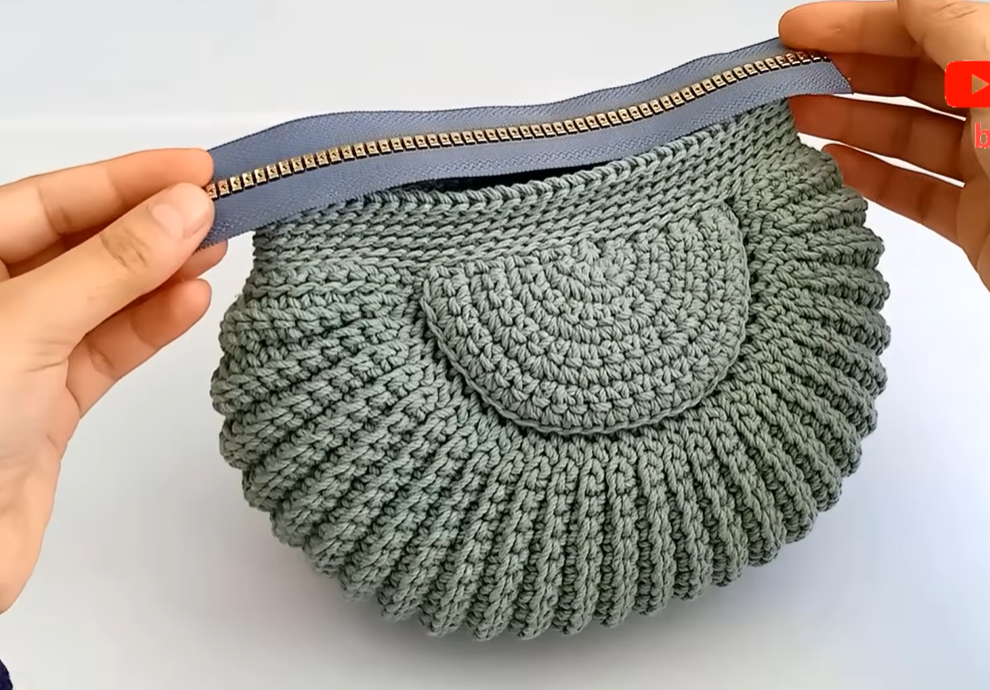
🧵 Part 4: The Opening Collar & Hardware
To prevent the bag from gaping open, we create a reinforced “lip” or collar.
- Slip Stitch Rounds: Turn the bag right-side out. Join yarn at the side seam.
- Rounds 1–6: Work one Slip Stitch into every row-end around the entire mouth of the bag.
- Note: Do not pull these slip stitches too tight, or the bag won’t open wide enough.
- This 6-round border creates a thick, leather-like trim.
- Zipper Installation: Using a needle and matching thread, sew the zipper to the inside of the slip-stitch collar. Position it so the teeth are just barely visible at the top.
- Final Details: * Sew the D-Rings to the side “peaks” of the bag.
- Attach your metallic chain.
- Optional: Add a silk tassel or a “Handmade” metal tag to the front.
Video Tutorial:
✨ Conclusion
Your Zenith Shell Bag is complete! Because of the macramé cord and the ribbed gusset, this bag has an architectural quality that holds up even when empty. It’s the perfect size for a “phone, lipstick, wallet” night out.
Would you like me to create a printable “Stitch Count Cheat Sheet” for the increase rows to help you keep track of your progress?