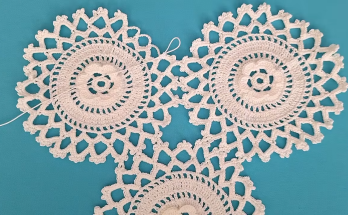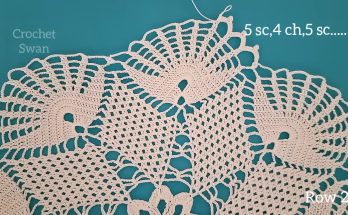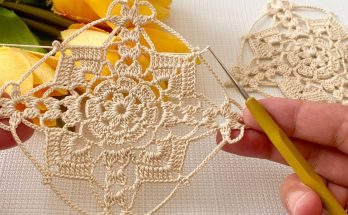
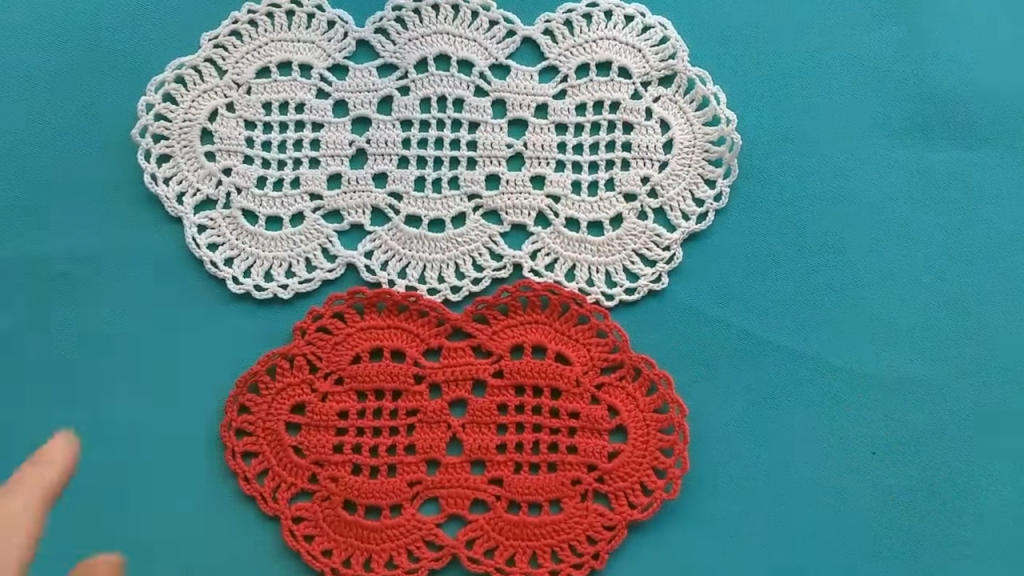
Welcome to the pattern for the Quilted Diamond Cluster Square Motif! This design is a stunning, textured square that creates a rich, padded fabric perfect for heirloom blankets, cozy cushion covers, or even a structured tote bag. It combines basic Double Crochet (DC) with a large, centralized puff stitch cluster to achieve a beautiful, quilted look with excellent definition.
This motif builds out from a small central circle, with each round adding complexity and establishing the square’s sharp corners.
🪡 Materials & Tools
| Icon | Item | Details |
| Yarn | Main Yarn (MC) | Worsted (Category 4) or Bulky (Category 5) yarn is recommended for the best texture definition. Choose a sturdy fiber like wool, acrylic, or a cotton blend. |
| Hook | Main Hook | 5.0 mm (H/8) or 5.5 mm (I/9), or the size needed to achieve a dense, firm gauge. |
| Notions | Finishing Tools | Scissors, Tapestry Needle (for weaving ends), Stitch Markers (critical for marking corners). |
Export to Sheets
📏 Sizing & Gauge
Consistent gauge is essential for joining, especially when working with textured stitches.
| Measurement | Result |
| Single Motif | Approx. 12 cm x 12 cm (4.7 x 4.7 inches) after blocking, using Worsted weight yarn. |
| Gauge Swatch | After completing Round 4, the side length should measure approximately 5 cm (2 inches). |
| Note | The final size is flexible; work the pattern until the desired dimensions are achieved, ending on an even-numbered round. |
Export to Sheets
🧶 Abbreviations & Special Stitches
This pattern uses US terminology. The key texture is created by the Puff Cluster (PC).
| Abbreviation | U.S. Terminology | Description |
| ch | Chain | |
| sl st | Slip Stitch | |
| sc | Single Crochet | |
| dc | Double Crochet | |
| tr | Treble Crochet | |
| sp | Space | |
| sk | Skip | |
| st(s) | Stitch(es) |
Export to Sheets
🌟 Special Stitch: Puff Cluster (PC)
Work 5 partial DC stitches together into the same stitch or space.
- PC: Yarn over (YO), insert hook into the specified stitch/space, YO, pull up a loop (3 loops on hook). [YO, insert hook into the same space, YO, pull up a loop] 4 more times (total 11 loops on hook). YO, pull through all 11 loops. Ch 1 to close/lock the puff.
🔳 The Motif Pattern: The Quilted Diamond Cluster
Foundation Round (Starting Point): Start with a Magic Ring, OR Ch 4 and sl st to the first ch to form a ring.

Round 1 (Initial Clusters): Ch 3 (counts as 1 dc). Work 2 dc into the ring, ch 2. Rep [3 dc into the ring, ch 2] 3 more times. Sl st to the top of the starting Ch 3 to join. (12 dc, 4 ch-2 spaces).
Round 2 (Defining Corners): Sl st into the next 2 dc to move to the first ch-2 space. Ch 3 (counts as 1 dc). Work (2 dc, ch 2, 3 dc) into the ch-2 space (First Corner made). Rep [ch 1, sk 3 dc, (3 dc, ch 2, 3 dc) into the next ch-2 space] 3 more times. Ch 1, sl st to the top of the starting Ch 3 to join. (24 dc, 4 ch-2 corners, 4 ch-1 side spaces).
Round 3 (First Texture Layer): Ch 3 (counts as 1 dc). Dc in the next 2 dc.
- Corner: Work [(2 dc, ch 2, 2 dc) into the ch-2 corner sp]. Dc in the next 3 dc.
- Side: Work [ch 2, sk the ch-1 sp, dc in the next 3 dc].
- Repeat: Rep the entire sequence [Corner, Side] two more times.
- Final Corner: Work [(2 dc, ch 2, 2 dc) into the ch-2 corner sp]. Dc in the next 3 dc.
- Final Side: Ch 2, sl st to the top of the starting Ch 3 to join. (36 dc, 4 ch-2 corners, 4 ch-2 side spaces).

Round 4 (The Central Puff Cluster): Sl st into the next dc. Ch 3 (counts as 1 dc). Dc in the next 3 dc.
- Corner: Work [(2 dc, ch 2, 2 dc) into the ch-2 corner sp]. Dc in the next 5 dc.
- Side: Work [sk 2 dc, PC (Puff Cluster) into the ch-2 sp, sk 2 dc, dc in the next 5 dc].
- Repeat: Rep the entire sequence [Corner, Side] two more times.
- Final Corner: Work [(2 dc, ch 2, 2 dc) into the ch-2 corner sp]. Dc in the next 5 dc.
- Final Side: Sk 2 dc, PC into the ch-2 sp, sk 2 dc, dc in the last dc. Sl st to the top of the starting Ch 3. (44 dc, 4 PC, 4 ch-2 corners).
Round 5 (Solid Frame): Ch 3 (counts as 1 dc). Dc in each st until the first corner ch-2 sp. (Note: DC in the top of the PC, not the ch-1).
- Corner: Work [(2 dc, ch 2, 2 dc) into the ch-2 corner sp].
- Side: Dc in each st across the side.
- Repeat around all four sides. Sl st to the top of the starting Ch 3 to join. (60 dc, 4 ch-2 corners).
Round 6 (Diamond Expansion – SC Layer): This round prepares the field for the next set of texture, defining the “diamond” shape. Ch 1 (does not count as st). Sc in each st until the first corner ch-2 sp.
- Corner: Work [(sc, ch 3, sc) into the ch-2 corner sp].
- Side: Sc in each st across the side.
- Repeat around all four sides. Sl st to the starting Ch 1 to join.
Round 7 (Final Joining Round): Ch 3 (counts as 1 dc). Dc in each sc across the side until the first corner ch-3 sp.
- Corner: Work [(2 dc, ch 2, 2 dc) into the ch-3 corner sp].
- Side: Dc in each sc across the side.
- Repeat around all four sides. Sl st to the top of the starting Ch 3 to join. (84 dc, 4 ch-2 corners).
✂️ Joining & Finishing
This sturdy motif is best joined with a simple, strong seam.
- Blocking: Due to the pronounced texture of the Puff Clusters, steam or wet blocking is crucial to ensure the squares lay flat and the seams match up perfectly. Pin firmly and allow to dry.
- Joining Method (Whipstitch Seam): This creates a strong, invisible seam perfect for heavy blankets.
- Align two squares with Wrong Sides (WS) together.
- Using a yarn needle and a new strand of yarn, whipstitch through the back loops only of both squares from corner to corner.
- Joining Method (SC Seam): This creates a textured, raised seam that highlights the square edges.
- Align two squares with WS together.
- Using the hook, SC through the corresponding outer loops (front loop of the front square, back loop of the back square) of both squares from corner to corner.
- Weaving Ends: Weave all tails securely into the backs of the DC stitches and behind the Puff Clusters.
- Border (Optional): Once all squares are joined, work 2-3 final rounds of simple SC or DC around the perimeter of the entire blanket/item, ensuring a consistent increase
(st, ch 2, st)in each of the four main corners.